
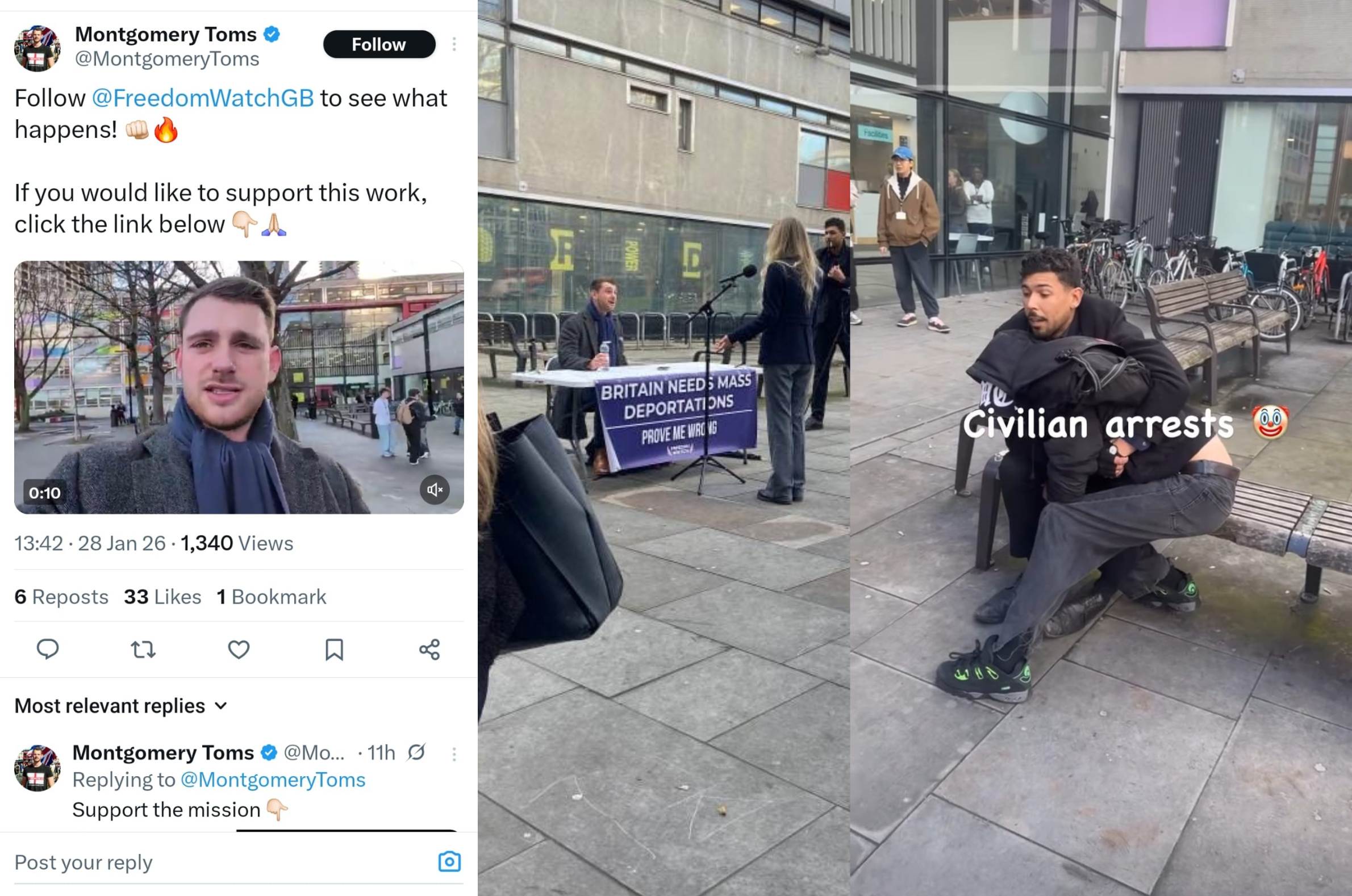
On the 28th January, former London College of Communication student Montgomery Toms, a right-wing activist and founder of the group Freedom Watch GB, set up a table outside UAL’s LCC campus with the banner declaring ‘Britain Needs Mass Deportations. Prove Me Wrong. Copying the style of American right-wing provocateur Steven Crowder, whose routine was to show up on campus with a deliberately provocative statement, Toms invited students to engage in ‘discussion’, while filming the encounters for social media content.
What unfolded on LCC’s campus was predictable: not merely disagreement over immigration, but a provocation engineered to elicit confrontation. UAL’s diverse community meant Toms’ message landed as a personal attack, not as abstract policy. The resulting clash highlights urgent questions: who should feel safe at university, and when does free speech cross into intimidation?
What Happened?
The altercation, widely shared on social media (most notably X – formerly Twitter), shows Toms mid-heated discussion with a student, when another student, approached the table from behind before flipping it and sending recording equipment flying. Almost immediately, Toms’s cameraman, Will Coleshill, steps in, physically restraining the student and attempting to perform a ‘citizen’s arrest’ – claiming the student had damaged equipment. A physical struggle ensued, with Coleshill placing the student in a near-headlock and alleging the student bit him. Campus security, lecturers and staff members physically intervened, while multiple people (including Toms himself) called the police.
When asking for a comment by the student who flipped the table, he stated, “I listened to what he was saying and felt like I had to do something. My intention wasn’t violence, so I thought flipping the table would disrupt them but not hurt anyone.”
Officers arrived on the scene. Footage shows them assessing the situation and explicitly acknowledging the provocative nature of the banner. One officer states that the banner was “going to rile people up” and advises Toms that “If you don’t want things to kick off, I suggest you don’t create a situation.”
Shortly after, another altercation takes place, this time between Will Coleshill and a number of police officers, during which Coleshill was wrestled to the ground, arrested and carried into the back of a police van by 7 officers as cheers and applause can be heard from onlookers. He was later charged with common assault and obstructing the police.
Who is Montgomery Toms?
Toms, alleged to have been expelled from BA Photography over allegations of racism after only spending 3 weeks at LCC, garners attention through these provocative street debates, describing himself as an activist on free speech and someone who challenges mainstream narratives.
His self-described ‘activism’ began with being politically active at the age of 14 during the COVID-19 lockdowns and has since focused on a range of issues, including opposition to immigration, climate crisis denial, and criticism of the COVID-19 lockdown and vaccines.
Through standard right-wing policies, Toms argues that global authoritarianism is “drip-feeding its way into Western culture.” Toms also actively criticises LGBTQ+ movements, international bodies ( e.g. UN, WHF, etc.), Net Zero climate targets, and general opposition to forms of centralised governance. Toms publicly reiterates that he doesn’t want a government to tell him and the people what to do or say.
Although Toms claims to ‘engage young people,’ critics argue his confrontations are crafted to manufacture outrage and boost social engagement—not foster honest discussion. The pandemonium that erupted seems to have served exactly that aim.
The Reaction
The university has officially commented on the situation, stating that “UAL is committed to upholding freedom of expression within the law and ensuring the safety of our students and staff. While incidents of this kind are rare, we have established processes in place to respond quickly. We regularly review and update our approach to maintain a safe and supportive environment. LCC will continue to have security on site to respond to any potential incidents.” The university emphasises that support to those affected is available through the university’s mental health services and invites any student to contact the Dean of Students, Mark Crawley, directly with any of their concerns.
The university has also emphasised that the incident happened in the public realm. However, advises students that if a similar situation like this were to arise in the future, students should not engage directly and instead inform a member of the front desk who will deal with the situation appropriately and ensure the safety of students.
The events have since prompted much discussion, one student describing Toms’ actions as “provoking the bear”, adding, “you can’t walk onto campus with a sign like that and then act surprised when people get hurt or angry. It’s like me walking into a Reform conference with a sign saying ‘Britain Needs More Gay Marriage’. I wouldn’t be shocked if I got hurled aggression.”
Supporters of Toms have framed the incident as an attack on free speech; however, this ignores a crucial imbalance of powers.
Where Does This Leave Us?
This wasn’t a failure of debate but a deliberate provocation in a vulnerable space.
With almost 23,000 students representing 130 countries, UAL prides itself on being a multicultural, inclusive centre of learning for the creative community, attracting students from all over the globe, serving, in part, as a sanctuary of sorts. Elephant and Castle itself is the Latin American hub of London, where residents embrace vibrant culture, individuality and community.
This wasn’t a marginalised student speaking but a politically motivated activist bringing an explicitly hostile message into a space populated by international students and migrants, whose lives would be directly affected by these types of policies – Tom’s message was not just an abstract policy discussion, but more of a personal attack.
This style of street debate plays heavily into the general public having imperfect information, putting the person debating the ‘for’ argument in a position of power. If Montgomery Toms is that knowledgeable about the situation, why doesn’t he sit down and debate an expert? Instead of engaging with this sort of behaviour, we should walk past and not give any attention to them – a reaction is all they want.
Additionally, Tom’s release of selectively edited footage following the incident on his YouTube channel has fuelled further criticism. The full recordings haven’t been made public, in turn creating concerns about what has circulated being tipped in his favour. If the detentions were unlawful, why not release the full, unedited footage?
This example isn’t isolated but instead mirrors multiple incidents happening around the country, with the rise of Reform UK and Tommy Robinson, which aim to make inflammatory rhetoric normalised. These ideologies often selfishly disregard the real people who are targeted by them.
Universities are meant to be a place for learning, challenge and growth – not a stage for political theatre that puts students in harm’s way, all for internet virality. Free speech is something every human being should have; no matter what side of the fence you sit on, we can all agree upon that. However, it doesn’t excuse intimidation, hostility or the targeting of already marginalised groups.
Should the table have been flipped? Probably not. However, maybe the real question is not whether the students overreacted, but why are people so surprised that a slogan calling for mass deportations, displayed outside one of the most diverse universities in the world, led to anger at all.



Leave a Reply