
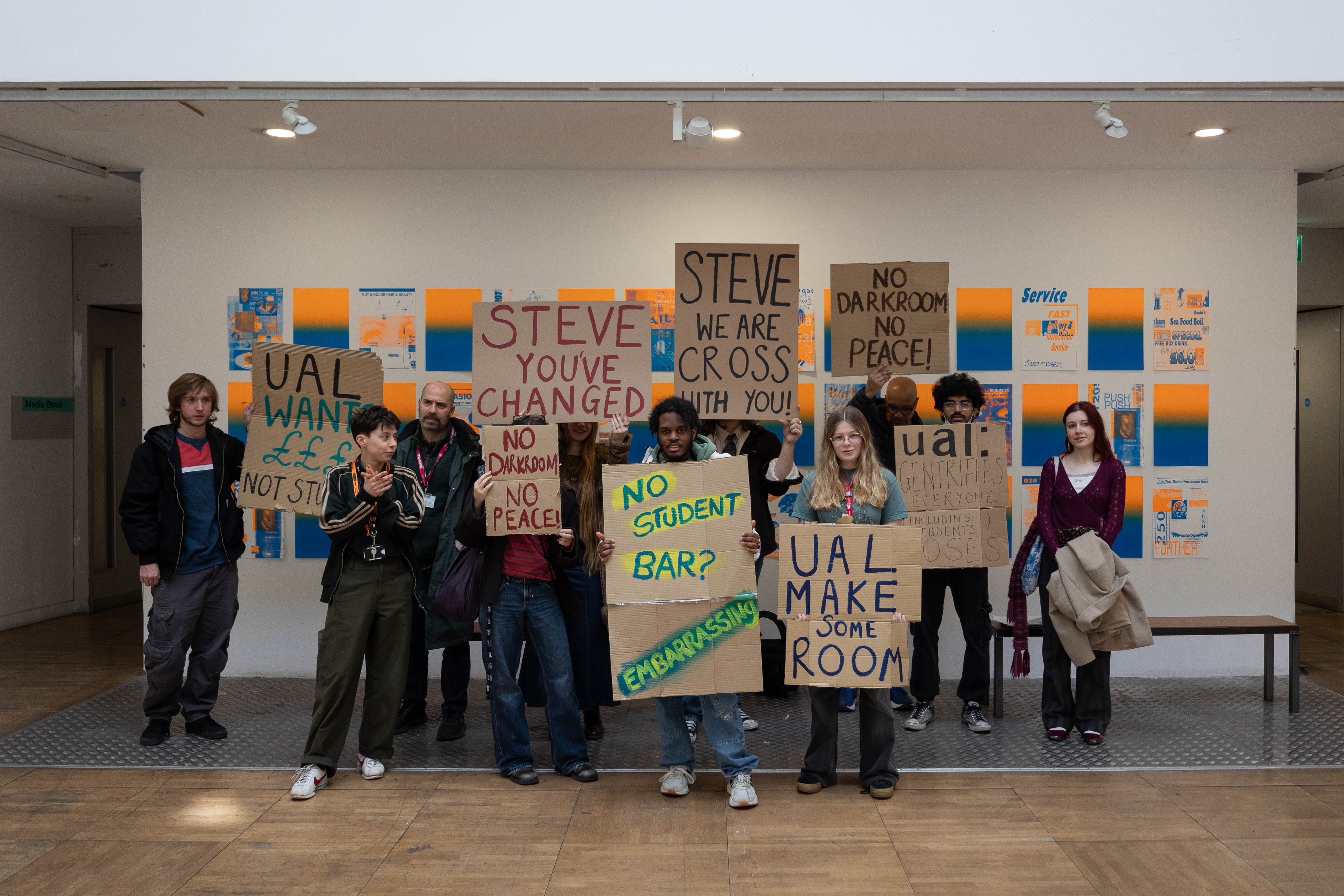
Photograph by Marianne Carney (via @artssulondon)
How The Darkroom Bar became a symbol in the fight against UAL’s privatisation issue
Darkroom Bar has not been a regular student bar for some time now.
In recent months, Save the Darkroom Bar posters proliferated on the LCC campus, a result of UAL’s plans to lose the bar in the college’s new building set to open in summer 2027.
A petition was organised by LCC Student Officer Zaine Cowan, which has, at the time of writing, amassed 1114 signatures.
A protest which marched to UAL offices, negotiations between students and UAL, and parties to raise awareness followed.
The fight to save Darkroom Bar is making so much noise because it is currently the only student-run bar accessible exclusively to students across all UAL campuses (CSM’s Platform Bar is also open to the public).
This means it hires students, the prices are considerably low, and all of the money made goes back to the student community instead of an external provider. This is not the case for UAL’s cafés, which are entirely externally staffed across campuses. It’s far from the London standard. UCL, KCL, and Imperial (among others) have multiple Union Bars, cafés and gyms that employ students, while LSE have their own Student Union Building.
While the UAL Press Office claims the Arts SU “has been consulted at every stage of planning”, with “over 600 students and members of staff” taking part in consultation workshops, SU’s Cowan claims the decision to get rid of the Darkroom Bar was made without the knowledge of the Student Union, and that the students didn’t know about the issue until the SU started a campaign to raise awareness about the bar’s closure.
“We signed this petition, we raised awareness, we built a community, now we need someone to fight for this,” Cowan says.
The protest against Darkroom’s closure took place on Tuesday March 10, on the LCC campus. A group of students and staff marched from the Darkroom Bar to the head UAL offices, demanding to speak with interim provost Steve Cross.
With cardboard signs, saying “Steve, we’re cross with you”, and “Steve, you’ve changed”, protestors chanted “No Darkroom, no peace”. They also delivered more than 150 letters signed by students who want to preserve the student bar in the college’s new building.
Steve Cross has considerable influence on the issue of LCC’s transition to the new building, so getting his support on the issue would be a crucial step in the campaign. Cowan claims Cross had usually been very student-focused, but on this issue, he’s acting with “apathy and disinterest. He’s still insistent on the issue being impossible.”
The crowd demanded a clear plan for a meeting on the issue between Cross, students, and staff. “We’re not actually leaving until we have the time and day next week,” one protester said.
Much of what Cross presents as a major obstacle to the inclusion of Darkroom Bar in the new building is a lack of finances and the impossibility of retrofitting spaces.
A spokesperson from UAL’s Press Office stated that UAL is “unable to make any significant changes to the design and layout without substantial financial, contractual, and legal implications, and delays to move-in dates.”
However, UAL’s LCF campus has been retrofitted before, as space was made for a Union art shop that initially wasn’t considered. Original plans have also been changed regarding the tenth floor of the new LCC building, which was facilitated to be a Creative Computing Institute.
“UAL has more than 22,000 students…Where is the money going?” Cowan wonders. He believes that more student community spaces could provide shelter from the recently growing anti-immigration and racist sentiments; a place where students could feel safe and respected. “The Darkroom has been so active in facilitating those student-led initiatives,” he says.
A part of the meeting on March 17 was held in the Darkroom Bar itself, with both Cross and Myers present. A considerable crowd of students also gathered there, taking turns to share what the bar means to them. The testimonials ranged from the bar “providing a safe space on campus” to concerns over “the loss of third spaces.”

Cowan says it was also “a moment where students finally felt like they could hold management accountable.” They entered into a formal negotiation with Cross and Myers, questioning them and demanding to know the actual financial figures at play.
According to Cowan, they were not able to give a “clear, evidence-based response”, mentioning potential fines from £100k to £1.5 million.
Cross still maintained that the “reversal of the decision was impossible”, but along with Myers agreed on “workshopping conversations” that would focus on solutions rather than obstacles.
For now, some of the solutions proposed by the university involve a non-SU-affiliated pop-up bar, renting out Corsica Studios nightclub, and the Activities Studio in the new building.
“What UAL think student community looks like is really different from what students want,” Cowan says.
According to Cowan, the planned loss of Darkroom Bar is symptomatic of a much larger issue – a push towards “privatisation and commercialisation” across university campuses.
While the future of Darkroom Bar remains uncertain, the students’ love for the bar and what it represents is clear.
Following the meeting on March 17, the bar hosted a Save the Darkroom Party, which amassed a great number of students.
And it’s not too late to get involved. Join the campaign at 5 PM on Thursday April 16 – where else but the Darkroom Bar, of course.




Leave a Reply