
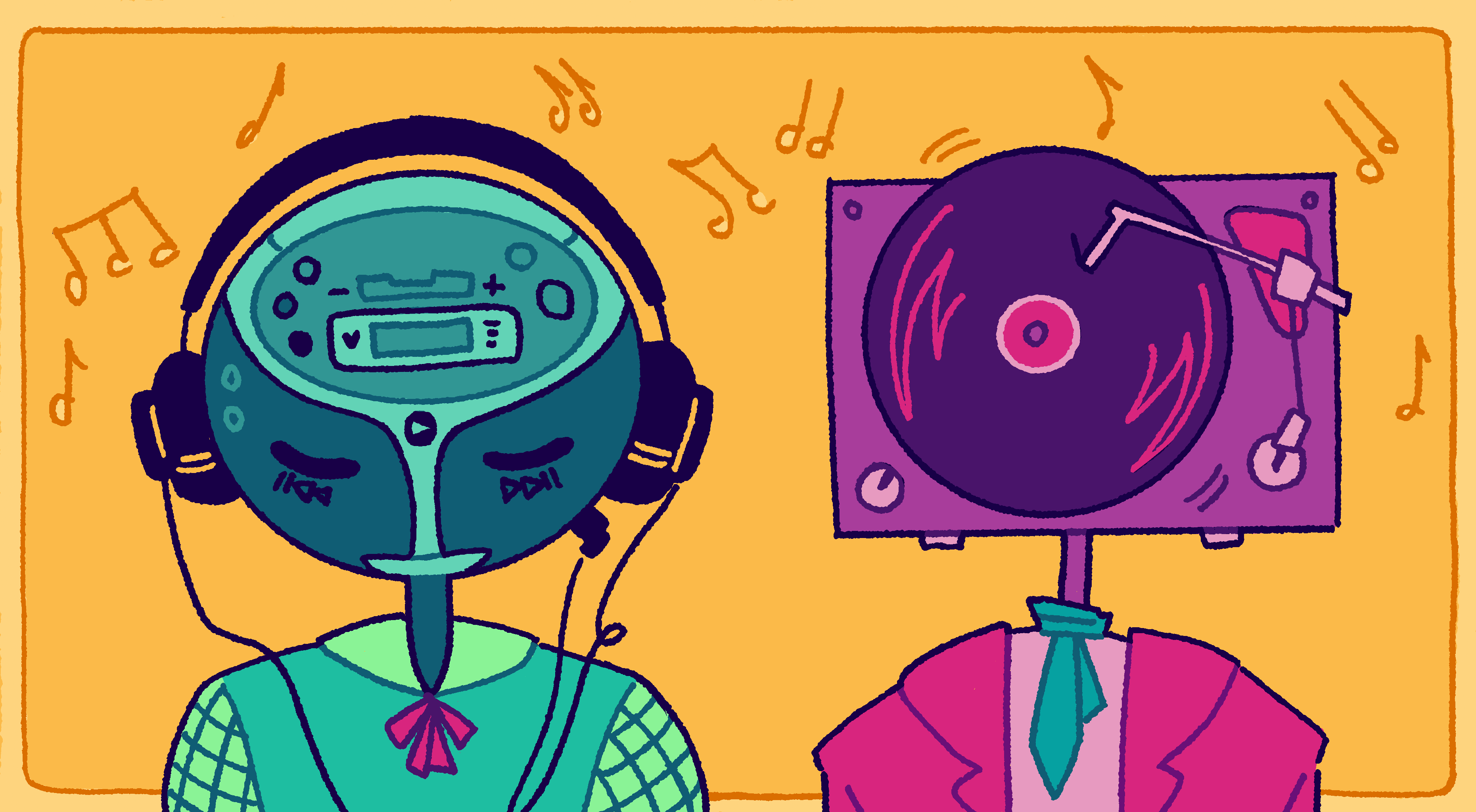
Illustration by Lauren Cheung
Before I sat down to write this piece, I spent 15 minutes sitting on my floor in front of a coffee table I found on the street. On it sits, from left to right, a speaker (L), a portable cassette player, a turntable, a stack of two silver cubes (the bottom housing a tape deck, the top a CD player and amplifier), a Sony D-E340 portable CD player, and another speaker (R). Beneath that table sit 234 CDs (208 albums, 26 singles), 41 vinyl records (30 albums, 11 singles) and 12 cassettes. What was I to listen to? What suited the moment? Why didn’t I just open Spotify?
A lever lowers, a needle crackles along the grooves of black vinyl, and a phone begins to ring — Debbie Harry answers, “I’m in the phonebooth, it’s the one across the hall.” Why does an original pressing of Blondie’s 1978 Parallel Lines sound so good?
My childhood living room had two white CD towers; they were clunky and beautiful. Years later, as a young adult, I stood in front of those towers and realised just how much they had influenced me. Names like Jeff Buckley, Pulp, and Massive Attack shone from their plastic casings — artists I adored, sitting on those shelves for 21 years, giving me a history that I was not yet aware of. The influence these tangible forms of music have had on me over my life is immense — immeasurable. That significance, that lingering connection to home, does not exist in the world of streaming, not with the same warmth and life. These are real things: plastic cases you can break, discs you can scratch, tapes you have to rewind yourself.
They are also something to share – they provide an experience. Like all physical media, they help keep us rooted in the real world.
That is something to nurture: the opportunity to share something real. The resurgence of physical media we are seeing can be hastily labelled performative or gimmicky. But head into a shop like Camberwell’s Dash the Henge or Sounds of the Universe in Soho, and the story changes. These are not forgotten worlds; they are alive – buzzing with crate diggers, heartwarming scenes plucked from the dreams of music nerds around the globe. Music has always fostered human connection; it’s always been evocative. As long as that is true (and it will always be true), doesn’t it deserve to be preserved?
The process of choosing and playing an album is not idle. It is not scrolling through an incessant screen and tapping a shuffle button; it is a simple but meditative experience. I get to look through these albums that I have collected over time and allow them to cast my mind to other places. I can see a Cranberries album and remember my mum giving it to me; I can play a Billie Holiday record and know that it’s going to scratch at the very start of “Body and Soul”. What a privilege it is to hold and care for an album you love. Maybe it made you who you are today, maybe it just reminds you of your mum.
Streaming services certainly have their place — we know they’re not going anywhere, but is the experience not important? Is the way in which we hear our favourite albums not synonymous with their value? A good album demands attention; the things we love deserve intent.


Leave a Reply