
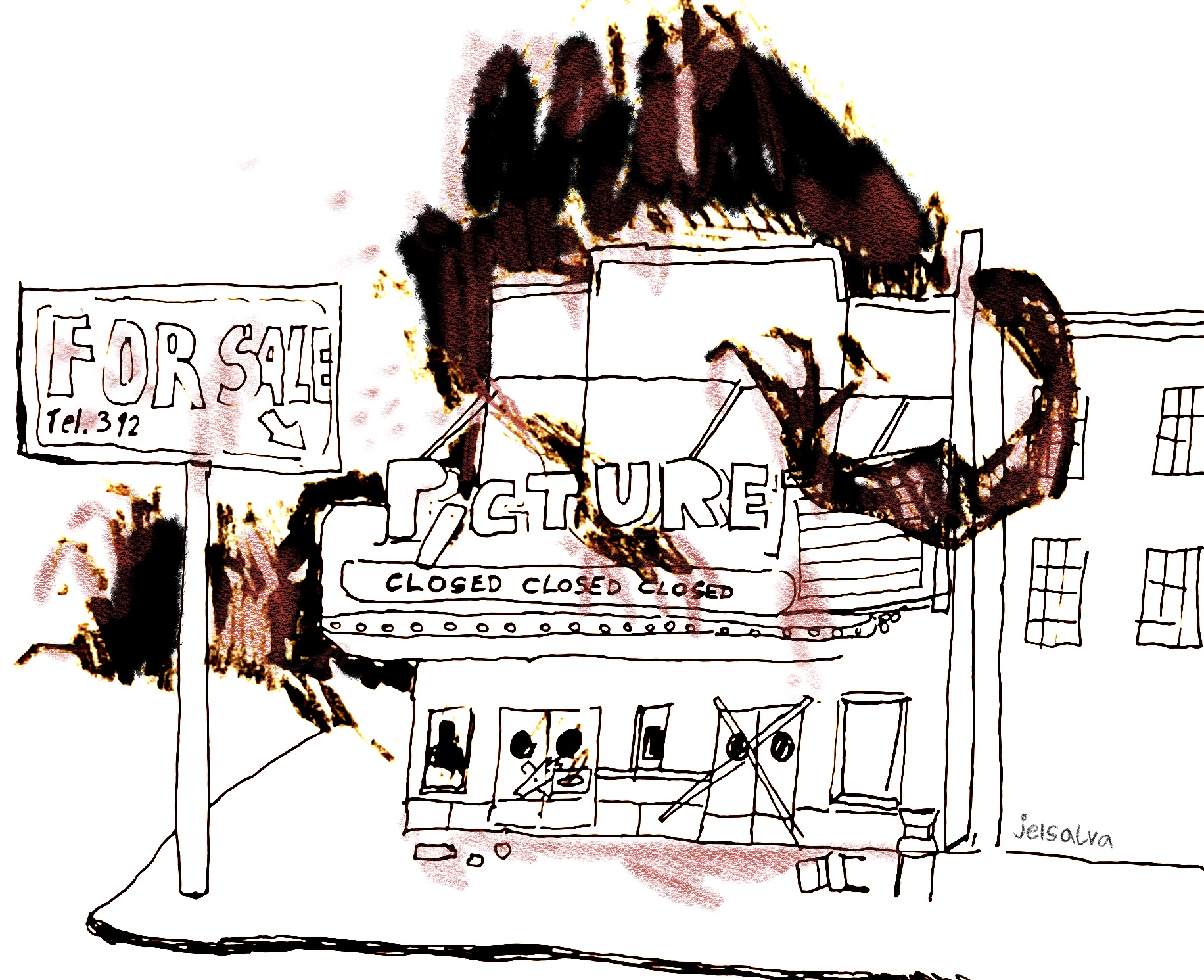
Illustration by Angela Salva
On the face of it, it may seem that the “death” of cinema-going has arisen due to the countless options we have to watch films from the comfort of our homes. But once we peel back the layers, we can see that maybe there is more to this decline than we may like to admit.
The lingering social effects of the pandemic – the mass reconstruction of what is considered to be “home” and what is considered to be “the outside” – have led to most becoming accustomed to enjoying entertainment exclusively from their sofas. As short-form media becomes our default entertainment source, spending time in a movie theatre can become uncomfortable, or worse, even boring. And to add insult to injury, cinema ticket prices have also increased, alongside the average run-time of films. In 1996, the average ticket price was just under £4, but as of 2025, that price has doubled.
Cinema seems to have become a luxury experience. A study shows that higher earners enjoyed the act of visiting the cinema and appreciated it as a “unique” experience, whilst those from lower-income means (see: much of the London student population) valued cheaper pricing. Clearly, the merits of streaming services have a far stronger appeal for the “broke generation”.
In our busy world, the idea of sitting for two or sometimes even three hours to watch a film which could easily be seen in minute-long increments on Instagram reels means that many opt for the latter. But this by no means is to say that we ought to shut down every cinema we can, simply because its use has become redundant.
More contemporary forms of cinema have emerged over the last decade, for example, experiences like “Fork ‘n Film”, where you can enjoy eating the specific dishes from your favourite film as you watch it. Two years ago, the first tickets for this experience (screening the family-favourite Ratatouille, set in the kitchens of Parisian haute cuisine) sold out within 0.8 seconds. This perhaps indicates that audiences are still in the market for “going to the movies” – just as long as they feel that they are paying for a novelty experience.
Other popular forms of cinema that have emerged, like “4DX” films, blend theatrical effects alongside the screening. The presence of light, wind, movement and water in the movie theatre is rather difficult to rig into your living room. The sound quality of a cinema is also distinctively irreplaceable: upcoming releases such as Wicked: For Good and K-Pop Demon Hunters are both films that require spot-on acoustics to focus our attention on the strong musical performances.
So whilst the act of cinema-going has certainly ceased to be the casual social activity it once was, it’s still certainly one of the best ways to experience a film at its purest form. With incredible spaces such as the Barbican, BFI and ICA (among many more) offering major student discounts, we at the Pigeon urge you to keep our cinemas alive!



Leave a Reply