
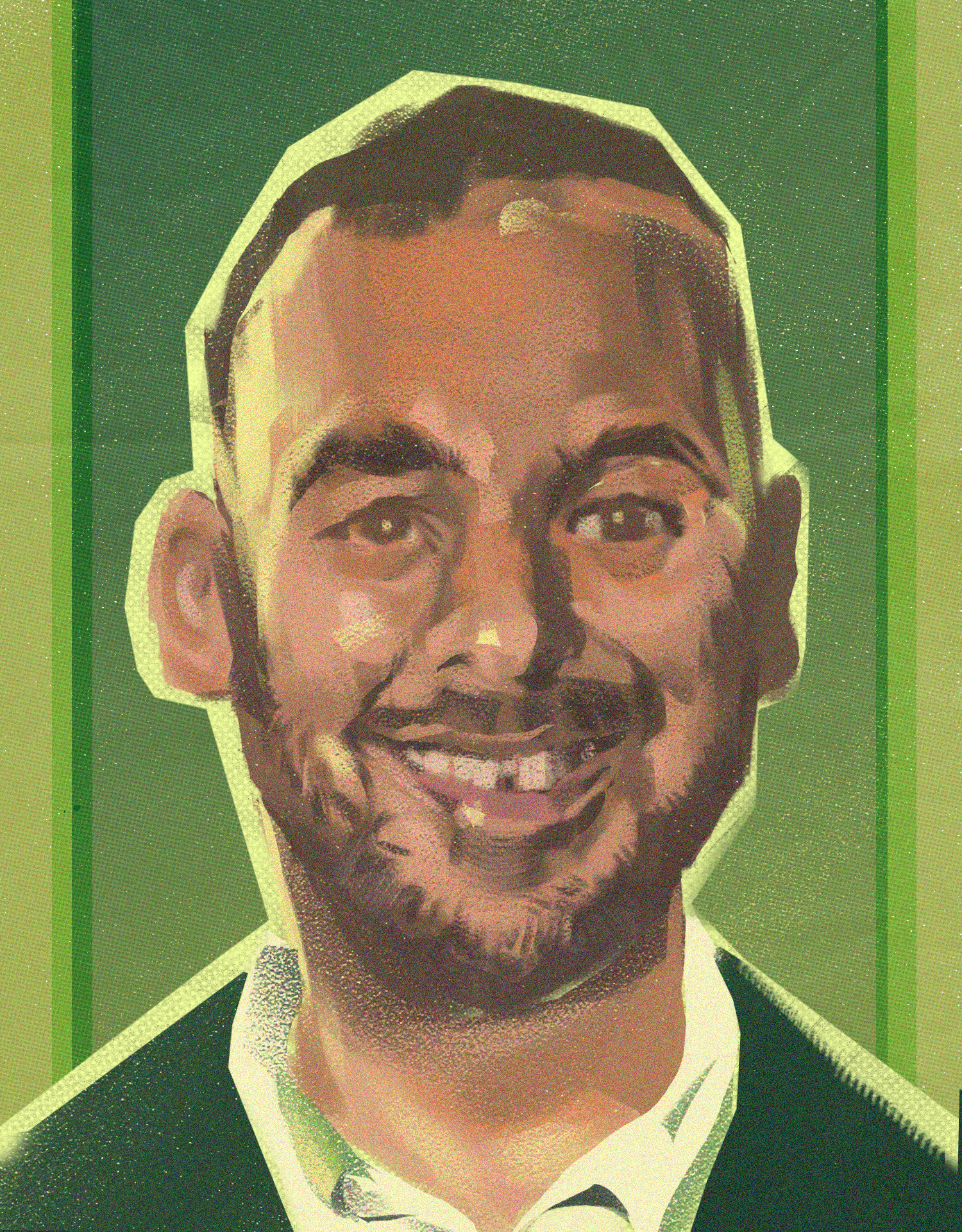
Illustration by Khoa Tran
On the evening of November 4th 2025, New York City voters celebrated the election of Zohran Mamdani (@zohrankmamdani) as their next mayor.
The 34-year-old democratic socialist, affordability advocate, and soon-to-be first Muslim mayor of New York ran a charismatic and captivating campaign whose success has been taken by many on the global left as reason to believe that ‘hope is back’.
“In this moment of political darkness, New York will be the light.” – Mamdani in his victory speech.
What The Guardian called Mamdani’s “out-of-nowhere, odds-defying, convention-shattering victory” came not from billionaire donors with vested interests but from a people-powered base of over 100,000 volunteers and an unwavering focus on providing real-life solutions to real-life problems, most notably the affordability crisis.
His campaign was driven by three specific, evidence-based promises to freeze the rent for 30% of apartments, make buses “fast and free”, and provide universal childcare for all. He has promised to achieve these policies in part by increasing taxes on corporations and high-income residents.
Here in the UK, people on the left watched Mamdani’s win with excitement, seeing his success as a seed of a new kind of politics, one that hears and caters to the needs of those struggling in society.
As right-wing reactionary politicians loom larger here in the UK, many leftists, especially younger people, are looking for some Mamdani-esque hope of their own.
“That’s my mayor! (I live in London)” reads a comment on a photo of Mamdani with his wife, Rama Duwaji, an illustrator, artist, and art school alumnus.
“Politics down so bad I’m excited about a mayoral election 2,000 miles away” reads a widely shared tweet about Mamdani’s election.
Enter Zack Polanski (@greenpartyzack), the Green Party’s new leader, whom many are calling the UK’s very own Mamdani.
Like Mamdani, Polanski is laser-focused on affordability; he wants to put a wealth tax on the super-rich, lower the cost of living, stand up for minorities and working-class people, and create a fairer, more welcoming nation for all.
“It is a political choice to keep children in poverty whilst billionaires and multimillionaires get richer, that’s just a fact, and any politician who says otherwise doesn’t have the public’s interests at heart,” Polanski said in a message to Labour’s Chancellor Rachel Reeves in November.
“Our country is and has been for a long time now at breaking point. Life has become literally unaffordable for millions of people. People are angry, and I get it; our communities deserve so much better. It is time for bold policies and bold choices that make a real difference to ordinary people”.
Polanski is running a bold campaign that speaks truth to power and seeks to unite voters in the real fight – not one political branch vs the other, but the top 1% (the super rich and politicians with vested interests) vs the bottom 99% (everyone else).
He’s on a roll: Green Party memberships have doubled since Polanski became leader in September, and it’s become the most popular party among young voters (YouGov poll) with the largest youth and student wing of any party in the UK.
“We’re offering a message of hope grounded in practical action,” Polanski told The Observer.
While so many politicians work hard to place blame on the most vulnerable in our society – whether that be asylum seekers, trans people, or benefit claimants – Polanski stands tall in his ardent advocacy for those very groups and brings the focus away from scapegoating and back to the real issues at hand.
In a recent BBC Question Time special on migration, Polanski demonstrated this, saying, “We know that we have huge issues in our country, but the issues with the NHS, the lack of council homes, and society feeling broken are not issues [brought by] migrants or someone who is clinging to a small boat. They’re the issues of 14 years of conservative austerity continued by a Labour government who say this is an island of strangers.”
Polanski, like Mamdani, reminds us that those who scapegoat and fearmonger with their bigoted, demonising, racist rhetoric seek not to help us but rather to divide and distract us from our common goals and shared humanity.
Too often, our generation’s concerns are harshly neglected, undermined, and underrepresented in politics. We are let down, disillusioned, and discouraged from dreaming of a brighter future. We are told that there is no alternative to austerity and that the downfalls of politics are unchangeable.
Mamdani’s win in NYC relied (in part) on actively engaging with and energising our generation via both effective social media presence and in real-life outreach and campaigning, showing others, including Polanski, the value of listening to public concerns and meeting young people with tangible hope.
In his victory speech, Mamdani gave a special shoutout to those young voters, saying,
“Thank you to the next generation of New Yorkers who refuse to accept that the promise of a better future was a relic of the past.
You showed that when politics speaks to you without condescension, we can usher in a new era of leadership.
Tonight, we have spoken in a clear voice: Hope is alive.”
Polanski, too, is offering us something new; speaking without condescension, he shows true interest in hearing young people’s concerns.
Whether that be concerns over ever affording a future, despair at our climate’s deterioration, or anger at our government’s complicity in Palestinian genocide, Polanski’s campaign addresses these issues. It presents us with hope for a less bleak world.
Although it is hard to trust that politicians will ever deliver on their promises, we cannot let despair lead us into a frightening, uncertain, and unaffordable future.
So let’s take New York’s lead and engage in building a political movement that genuinely wants to fight for us and, in the words of Zack Polanski,
“Let’s make hope normal again.”


Leave a Reply