
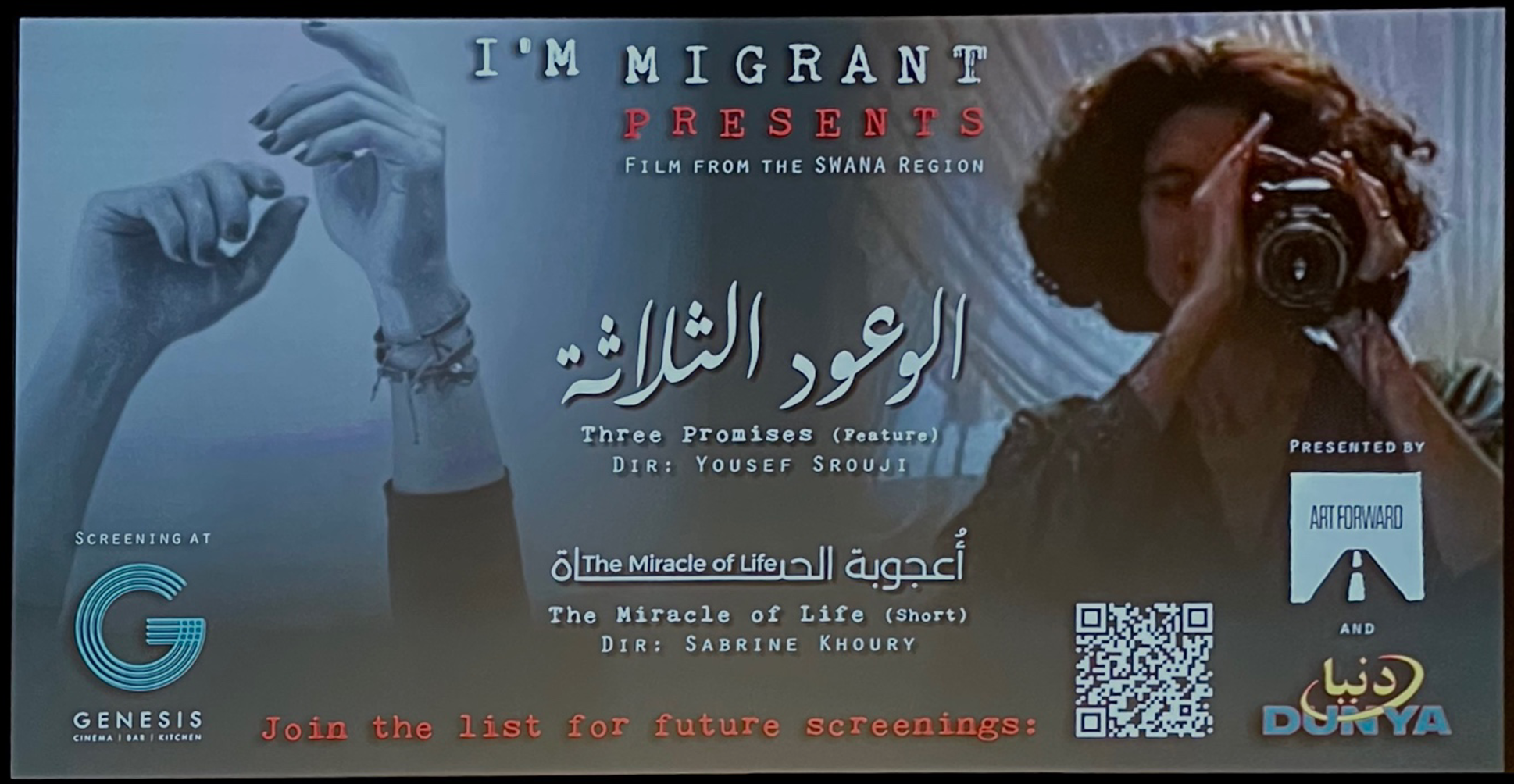
Filmmaker Sabrine Khoury intimately portrays the challenges of pregnancy while reflecting on the wider-scale trauma of genocide in her home country.
Screening at Genesis Cinema, 4th December – Photograph by Philippa Kline
Documentary-style short film The Miracle of Life tells the story of director Sabrine’s experience of pregnancy. She is shown within the home, in vulnerable moments such as bathing or resting. The film is shot entirely in black and white and combines animation with reality.
Sabrine’s voiceover, in Arabic, describes the realities of her pregnancy: pain, feeling like an alien in her own body, and nausea so intense she cannot keep water down. The refrain “And I cried, is this a legitimate reason to cry?” comes after her descriptions. This question is followed by an animation showing figures moving down a darkened road, with sounds of war and crying out in the background.
Sabrine created the film to “process” her pregnancy, yet also her complex feelings around watching suffering unfold in Palestine, her home country. “I felt pain, anxiety, changes in my body and identity, and fear of the unknown. At the same time, I was watching the genocide in Gaza from a safe home. That contrast created guilt and shame.” “I kept asking myself if I had the right to express my struggles while others were — and still are — living horrors I couldn’t imagine.”
The Miracle of Life world premiered at the Beirut International Women’s Film Festival, held from April 27th to May 3rd of this year. It has since won best documentary awards at Galway Film Fleadh and Integrazione Film Festival. The film was screened in London on the 4th of December at Genesis Cinema, as part of the I’m Migrant Film Festival, hosted by the organisation Art Forward.
Sabrine grew up in Nazareth, Palestine, and moved to the Netherlands with her husband seven years ago. She initially didn’t consider filmmaking a “real career.” “I even started studying biology, but after one semester, I ran away from it.” Yet, she always felt “drawn to art and storytelling.” She began making documentaries and short films while studying Film at Tel Aviv University.
In her filmmaking, Sabrine feels compelled to tell “stories about women’s lives, and the quiet parts of our experiences that are often overlooked.” The Miracle of Life does just this, disrupting dominant notions of pregnancy as a “joyful experience.” In reality, for Sabrine, “soon the happiness was shadowed by physical and emotional pain.”
The film also subverts traditional ideas of motherhood. At one point, Sabrine says she feels like a “hidden Victorian mother” — referring to a trend in which children were photographed with their mothers holding them, yet hidden by a curtain. “I felt a modern version of that pressure. People focus on the baby but rarely ask how the woman feels in that moment of transition.” Sabrine’s monologue throughout the film gives voice to these unheard experiences of mothers during pregnancy, as she describes each symptom she faces. “I wanted to give space to the woman behind the role.” In particular, she expresses the disorientation of experiencing pregnancy outside of her home country: “My motherhood journey is unfolding in a foreign tongue, unfamiliar to my own.”
The film not only showcases personal moments, but the filming process also carries this intimacy — being shot entirely by Sabrine’s husband, Rashed. “Having my husband behind the camera made it possible to be so vulnerable. I didn’t have to perform or pretend. I could be tired, emotional, and uncomfortable.” The film shows “real moments — sometimes while [Sabrine] was still in physical pain, or crying, or unable to sleep.” To film without a production crew, the pair worked with “a static camera, long takes, and stillness.”
Often shots are disembodied — a solitary hand, arm, or eye appears in close-up. In this way, Sabrine makes the body unfamiliar to the viewer, mirroring the experience of bodily changes during pregnancy.
The absence of colour also gives the film an abstract quality. Sabrine says, “I didn’t want the viewer to focus on colours, objects, or the background. I wanted them to focus on the emotional weight — the face, the breath, the small gestures…It also reflects how I felt during that time — everything looked heavy, unclear, and without colour.”
The use of animation further brings a surreal element to the documentary. Sabrine explains her decision to represent, rather than show, the genocide in Gaza: “I didn’t want to use real images of people’s suffering. It felt wrong to take pain that is real…and place it inside an artistic context.” Animation allowed a level of abstraction that ensured she did not exploit the suffering of others. “It creates a symbolic space.”
Although the visuals are representative, the “sounds of war…are real.” Quiet, domestic moments at home are starkly contrasted with this anguish. The film shows “these two worlds exist at the same time.” Although Sabrine was “in a safe home, far away from a genocide,” her “emotions were real — the physical pain of pregnancy, the identity shock, the loneliness.”
Now reflecting on the film’s central interrogation — “Is this a legitimate reason to cry?” — Sabrine says she is “still asking [herself] that question.” She believes, “Acknowledging our pain doesn’t erase the suffering of others.” However, it is important to place suffering in context: “We have the right to feel pain — but we also have the responsibility to recognise where we stand in the world.”


Leave a Reply