
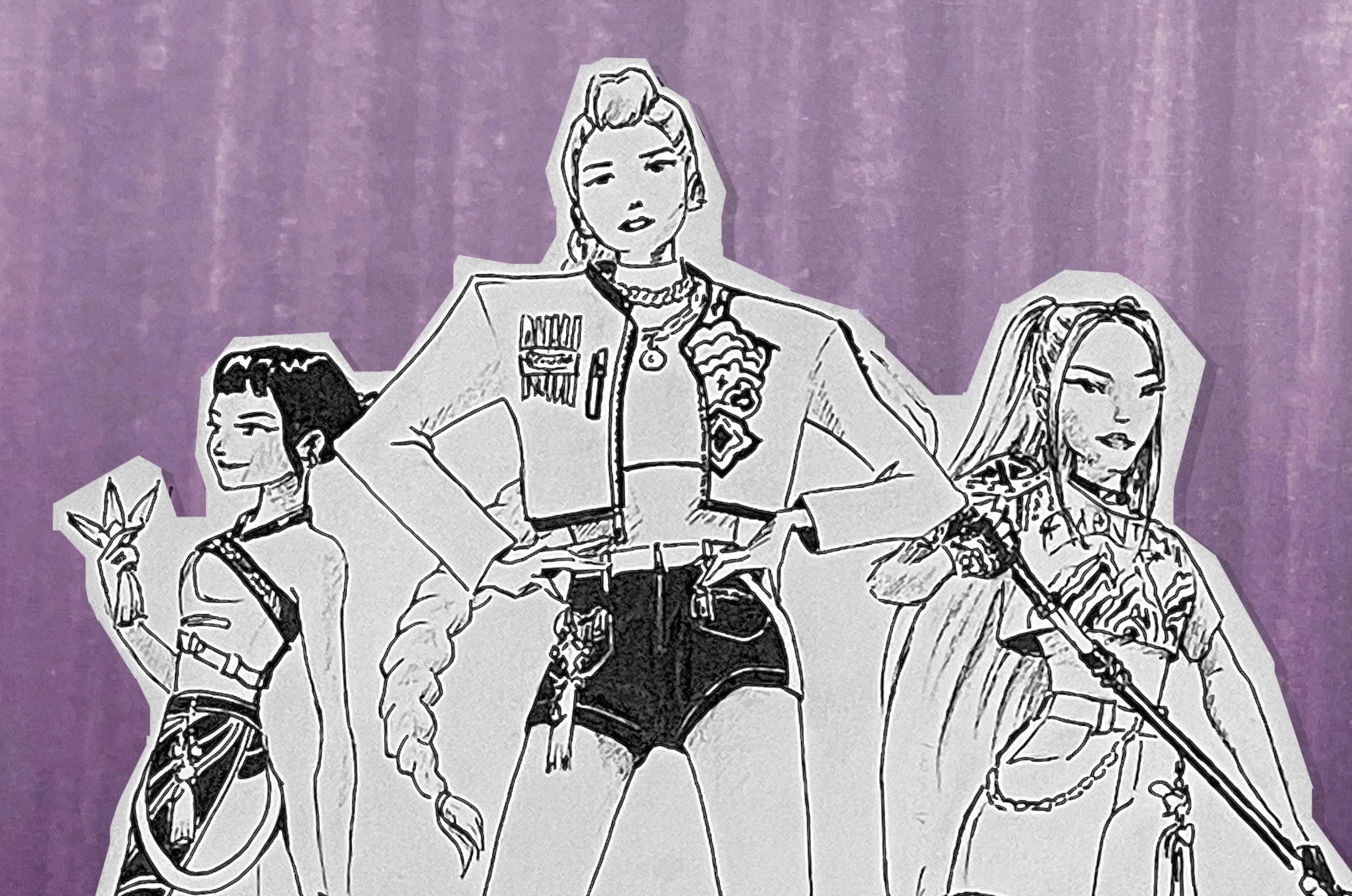
Illustration by Lara Antunez de Mayolo Daly
Opening Netflix and scrolling to “Kids Animation” will provide a whole host of TV shows and movies, which, if you navigate to certain social media sites, you will find have a substantial amount of adult fans. “Fandom” is no new concept, but with the growth of social media and content sharing, fan spaces have opened up to millions of people around the world. So why does content directed towards children amass such large adult fanbases, and why is the queer community at the centre of this following?
Media directed at children tends to be easy to follow and filled with light-hearted yet meaningful messages designed to engage its young audience in emotional reasoning. Often containing bright colours and fast-moving images, children’s media is simultaneously engaging and throwaway, introducing kids to new concepts whilst maintaining straightforward narratives. This resonates with adults, too. Episodic storylines with flowing conflict-and-resolution narratives can be a comforting escape from a world where problems are rarely solved so easily. Thus, many adults return to shows they watched as children out of nostalgia, and often discover they are getting something new out of it that they didn’t fully understand in childhood.
Queer people appear to be at the heart of this phenomenon, likely due to the lack of their light-hearted representation in adult media. There is also a desire to return to a time in their lives which, for many, was a period of uncertainty and confusion, and view it again in a more positive light. Many protagonists in children’s media, whether a result of their hobbies, looks, or personalities, are written as social outcasts. This is an incredibly relatable feeling to many LGBTQ+ people, who navigate life feeling like outsiders because of their sexual orientation or gender expression.
While queer representation in children’s media is scarce, the few examples we do possess have garnered massive followings in the years since their release. The most notable of these shows all feature canonical sapphic couples that subsequently create large overlap in fandom spaces, especially within the sapphic community. She-Ra and the Princesses of Power, The Owl House, and The Legend of Korra have a majority of teenage and adult fans. All three shows were written to younger audiences, but developed more mature topics and themes as showrunners realised the demographic they were attracting. Similar narrative development occurred with other classic children’s shows, such as Avatar: The Last Airbender, Voltron: Legendary Defender, Gravity Falls, and Steven Universe.
Showrunners have recently appeared to capitalise on this phenomenon, and adult audiences are now the expected demographic of what once would have been media “for children”. For example, when examined through content alone, 2025’s K-pop Demon Hunters upbeat K-pop soundtrack, innocent romantic storyline, and lack of curse words seem very clearly directed at a younger age group. When placed contextually, it becomes clear that ultimately the film was going to be enjoyed by existing fans of K-pop (a very complex and confusing corner of the internet – not a place young children are likely to be spending much time in), and those with the comprehension skills to see beneath the sparkly exterior to the more intense themes within the narrative.
Interestingly, all media mentioned thus far have been animated, tying into our discussion significantly and linking again to queer women. Women dating women is much more tolerated in society than men dating men. The patriarchal systems so ingrained in our society place men at the centre of everything, including lesbian relationships. Lesbians and sapphics are often fetishised, and are thus presented in adult media as a kink, rather than a genuine sexuality. Because animation is a medium used regularly for children’s media due to its potential for imaginative visuals, it is logical that the more popular sapphic relationships would employ the medium as well. Because these animations are aimed at children, the fetishised aspect is, thankfully, lost. This may also be interpreted as a way for queer showrunners to distribute their shows internationally. Female friendship is often expressed in ways that can appear romantic, such as women tending to be more physically touchy with each other. Thus, under the guise that characters are purely friends, the show can be sold to international markets where queerness is less accepted – a major theme explored in children’s media.
Whilst the phenomenon of adult fandom and children’s media is a discussion much bigger than this article can express, I hope this has given you some insight into this topic and how queer women are often at the frontline of these interesting explorations. Whilst we as queer people often take what we can get when it comes to representation, the desired next step is for showrunners and filmmakers to find a middle ground between children’s TV, where queer love can be played off as friendship, and mildly pornographic fetishised adult media, where queer women are written for the male gaze.


Leave a Reply